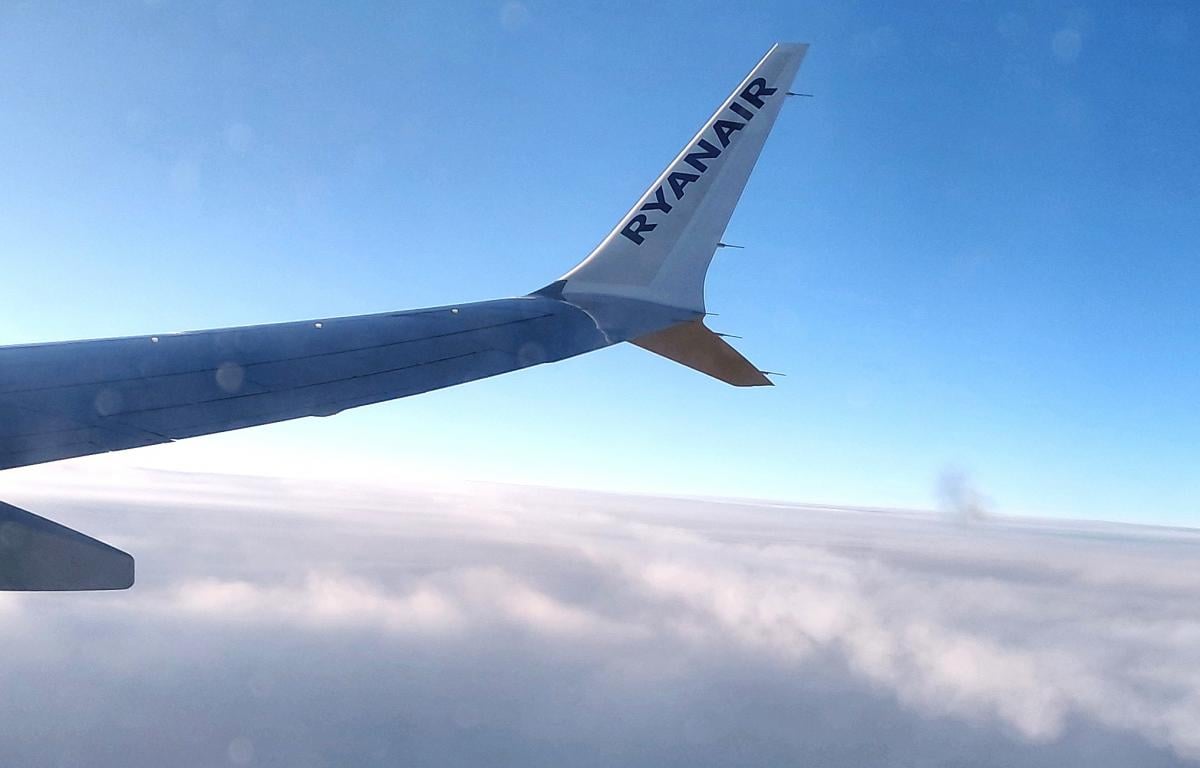
A Ryanair flight scheduled to land in the United Kingdom was diverted all the way to Spain after severe winds prevented it from touching down.
Flight FR2955 had departed from Dublin Airport at 22:19 on Saturday and was attempting to land at Bristol Airport when violent gusts linked to Storm Baelo made a safe arrival impossible.
According to flight tracking service AirNav Radar, the Boeing 737-800 aborted its approach, climbed away from the English coast, and flew nearly 1,600 kilometres south across the English Channel and France before touching down at Alicante-Elche Airport at 01:16 on Sunday morning.
The journey between Dublin and southwest England normally takes under 90 minutes. Instead, passengers spent approximately three hours in the air after the airliner cruised at 27,000 feet, descended towards Bristol, and was forced by ground conditions to turn towards the Mediterranean.
Aborted Bristol landing and diversion
The aircraft had already experienced a complicated operating schedule before the diversion. As reported by The Independent, the flight was originally intended to travel to Newquay in Cornwall before heading to Bristol.
A spokesperson for Ryanair explained that the service had originally been scheduled to fly from Alicante to Newquay on 24 October, but strong winds at Newquay Airport forced an initial diversion to Dublin.
The airline stated that passengers were kept on board in Dublin in the hope of departing as soon as a departure slot became available. However, worsening weather conditions along the route ultimately required the aircraft to return directly to Alicante.
Ryanair said that passengers were kept informed of the disruptions through email updates, mobile push notifications, and ground staff at Alicante Airport. The carrier provided affected travellers with overnight hotel accommodation and rebooked them onto the next available flights.
Storm Baelo damage and weather warnings
Flight FR2955 was part of widespread travel disruption caused by Storm Baelo as it swept across the United Kingdom over the weekend, bringing destructive wind gusts of up to 84 miles per hour, or approximately 135 kilometres per hour.
Two men were killed during the storm when trees collapsed onto them, and hundreds of thousands of homes were left without electricity across the country.
The UK Met Office issued an amber weather warning for strong winds covering Scotland and large sections of northern England. The alert took effect at 21:00 on Saturday and remained active until 21:00 on Monday. Storm Baelo formed only hours after the season's first named storm, Austin, had subsided in the southwest of the country.
Transport networks across Britain suffered severe disruption throughout Sunday. In Scotland, fallen trees and hazardous conditions forced authorities to close several major highways as well as multiple railway routes.
Flight cancellations at UK airports
Aviation hubs across the country faced severe backlogs, with dozens of flights cancelled on Sunday at London Heathrow and London Gatwick, the two busiest airports in the United Kingdom.
A wide range of carriers were forced to ground services. British Airways cancelled flights connecting London to Edinburgh, Paris, Rome, and Aberdeen. LoganAir grounded flights to the Isle of Man, while EasyJet called off departures to Amsterdam and Jersey.
Other cancellations across the two major hubs included Aer Lingus flights to Dublin, Air France services to Paris, Lufthansa departures to Frankfurt, Vueling flights to Barcelona, Emirates flights to Dubai, and a Riyadh Air service to Qassim.
Earthquake disruptions in Sicily
Severe weather in the north coincided with natural disruption elsewhere in European travel corridors, as a sequence of up to 10 earthquakes struck off the coast of Sicily.
Italy's National Institute of Geophysics and Volcanology reported that the tremors had their epicentre in the southern Tyrrhenian Sea, northwest of the Aeolian Islands. The strongest earthquake registered a magnitude of 5.7, sending residents in the coastal city of Palermo out into the streets in search of safety.
Authorities in Palermo evacuated several schools as a precautionary measure, while court personnel were evacuated from a judicial building in the western city of Trapani. On the island of Filicudi, located within the Aeolian archipelago, the seismic activity triggered a partial cliff collapse.