

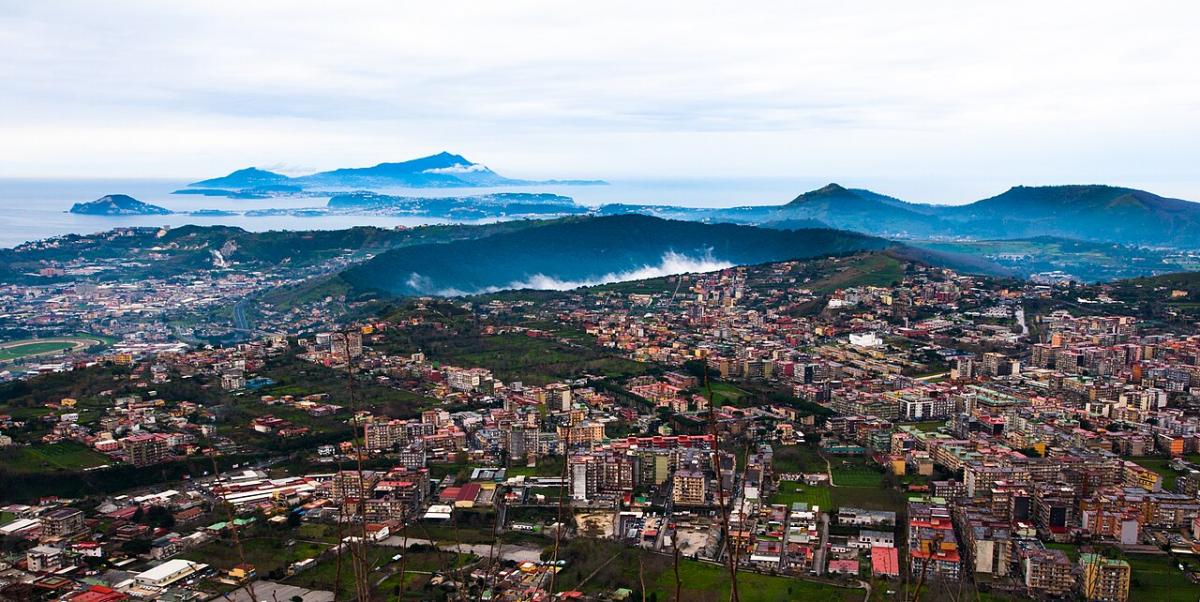
About 500,000 people live within the Campi Flegrei caldera, one of the world's most dangerous volcanic zones near Naples, Italy, where intensifying earthquakes have damaged buildings and forced residents from their homes, the Financial Times reported.
The Campi Flegrei area has recorded frequent underground tremors for decades, but the quakes have grown stronger in recent years as gases and magma accumulate underground and move toward the surface. A quake on July 31 was one of the strongest to hit the region in decades.
Carlo Doglioni, the former president of Italy's National Institute of Geophysics and Volcanology, said Campi Flegrei is one of the most dangerous volcanoes not only in Italy but in the world. He said that when people are there, they do not feel the danger, because they see the sea and beautiful scenery, and the place is wonderful, so people say they accept the risk.
Although scientists see no signs of an imminent eruption, the earthquakes have caused serious problems for communities living on the caldera.
Residents forced from damaged homes
In the city of Pozzuoli, nearly 5,700 residents were forced to leave their homes after the powerful summer earthquake. The tremors shook local buildings so badly that many, although they remained standing, have now been declared unsafe to live in.
Doglioni said people now realize Campi Flegrei is dangerous, and that the number of earthquakes has grown over the past few years. He said the quakes' sources are very close to the surface, which is why the shaking is so strong.
How officials plan to cut the risk
Last month, about 700 residents of Campi Flegrei, along with the mayors of affected municipalities, traveled to Rome to demand that the government increase funding and simplify bureaucratic procedures to speed up urgent building reinforcement and let people return to damaged homes.
Around the same time, the government approved a ten-year, 1 billion euro support plan for Campi Flegrei. It includes subsidies covering up to 70% of the cost of seismic reinforcement work on private homes, as well as better preparation for a possible emergency evacuation.
Presenting the plan, Civil Protection Minister Nello Musumeci said the state does not promise the impossible by eliminating the risk entirely, but it does commit to reducing the level of danger and people's vulnerability.
Musumeci said residents would be encouraged with financial incentives to leave the area, which is known for affordable housing and scenic countryside near Naples. He said voluntary resettlement needed to be encouraged, at least from the most vulnerable buildings and the highest-risk areas, while acknowledging that calls for resettlement are a politically very sensitive issue.
A caldera showing signs of activity
The last eruption at Campi Flegrei occurred in 1538, after which the area stayed quiet for centuries and was gradually built up. In recent decades, however, the caldera has again shown signs of activity: since 1950, the ground near Pozzuoli has risen by about 4.6 meters. Volcanologists do not rule out a future eruption, which could require a mass evacuation.
Christopher Kilburn, a volcanologist and director of the Hazard Centre at University College London, said there is no clear evidence an eruption will happen or that it will happen soon, and that this creates a major dilemma. He said that while people usually live around a volcano, here they live directly on top of it, so if an eruption happens, it will happen right beneath their feet.
Italy keeps constant watch on the caldera through the Vesuvius Observatory, where scientists continuously track seismic activity, toxic gas emissions and the rate of ground uplift.
Lucia Pappalardo, the observatory's director, said these readings allow early signs of an approaching eruption to be detected so people have time to evacuate. The round-the-clock control room has a dedicated direct line to Italy's civil protection department, which would coordinate any evacuation.
Pappalardo said an eruption can be predicted, so people would be able to save their lives. She cautioned, however, that even then local residents would suffer enormous losses, saying people's lives can be saved but not their buildings and homes, and that this is something they have to live with and accept as the risk of losing everything they have.
A bitter history of evacuation
In the 1970s and 1980s, a long period of continuous weak tremors forced the evacuation of tens of thousands of people from the historic center of Pozzuoli, leaving behind bitterness and distrust of the authorities. Local authorities later spent nearly 200 million euros turning the abandoned historic center into a tourist complex, but the project remains unfinished and the area is still empty.
Earthquakes reshape daily life
Many homes in the area are not built to withstand strong tremors, and part of the population left after the July earthquake. Antonio Impesi, who owns a bar on Pozzuoli's historic waterfront, said there is almost no one left, and that if you walk through town in the evening, everything around is dark.
People whose homes were declared unfit for habitation now face a difficult situation, since high property prices around Naples make it hard to find other housing, and repairing damaged buildings can take a long time and cost a lot.
The earthquake also damaged 20 historic Catholic churches in Pozzuoli, some built as far back as the 17th century. All were declared unsafe to visit after the July tremors, and the government plans to allocate 10 million euros for their seismic reinforcement.
Local priest Roberto Della Rocca said there is a strong desire to return everything to normal life, since in Pozzuoli an emergency situation exists alongside ordinary daily life. He said residents are monitoring the damage and trying to work out how to proceed, but that the situation is not simple.
Anna Nasti, a 39-year-old teacher raising two school-age children, has lived in Pozzuoli her whole life. Her family lived in a social housing complex built after World War II near the waterfront, but the buildings, home to 96 families, were badly damaged in the recent earthquake and are now set to be demolished.
Like others left homeless by the earthquake, Nasti receives 750 euros a month to rent another apartment, but she said that is not enough to rent housing in Naples, where property prices are very high, so she and her children have had to stay temporarily with friends.
Nasti said she cannot come to terms with the idea of taking her children away from the coastal community where her family has lived for three generations, comparing leaving Pozzuoli to abandoning a child who will not listen to you, and saying it is very hard for her to let the place go.
Decades of unrest beneath the surface
Nearly 500 years after its last eruption, Campi Flegrei continues to show activity, with decades of ground uplift, earthquakes and gas emissions observed in the area. Research by specialists at University College London and Italy's National Institute of Geophysics and Volcanology found that prolonged deformation has gradually weakened the upper layers of the Earth's crust. The scientists believe that since around 2020, part of this change has resulted from the fracturing of rock and movement along faults, rather than from bending alone.
What happens next
The government's ten-year, 1 billion euro support plan will fund seismic reinforcement subsidies, encourage voluntary resettlement, and improve emergency evacuation preparedness; 10 million euros is also planned for reinforcing 20 damaged historic churches in Pozzuoli.
Test yourself
How many Pozzuoli residents were forced from their homes after the July 31 earthquake?
How much has the ground near Pozzuoli risen since 1950?
What does Italy's new support plan for Campi Flegrei cover?
Where it happened
Pozzuoli, Italy


