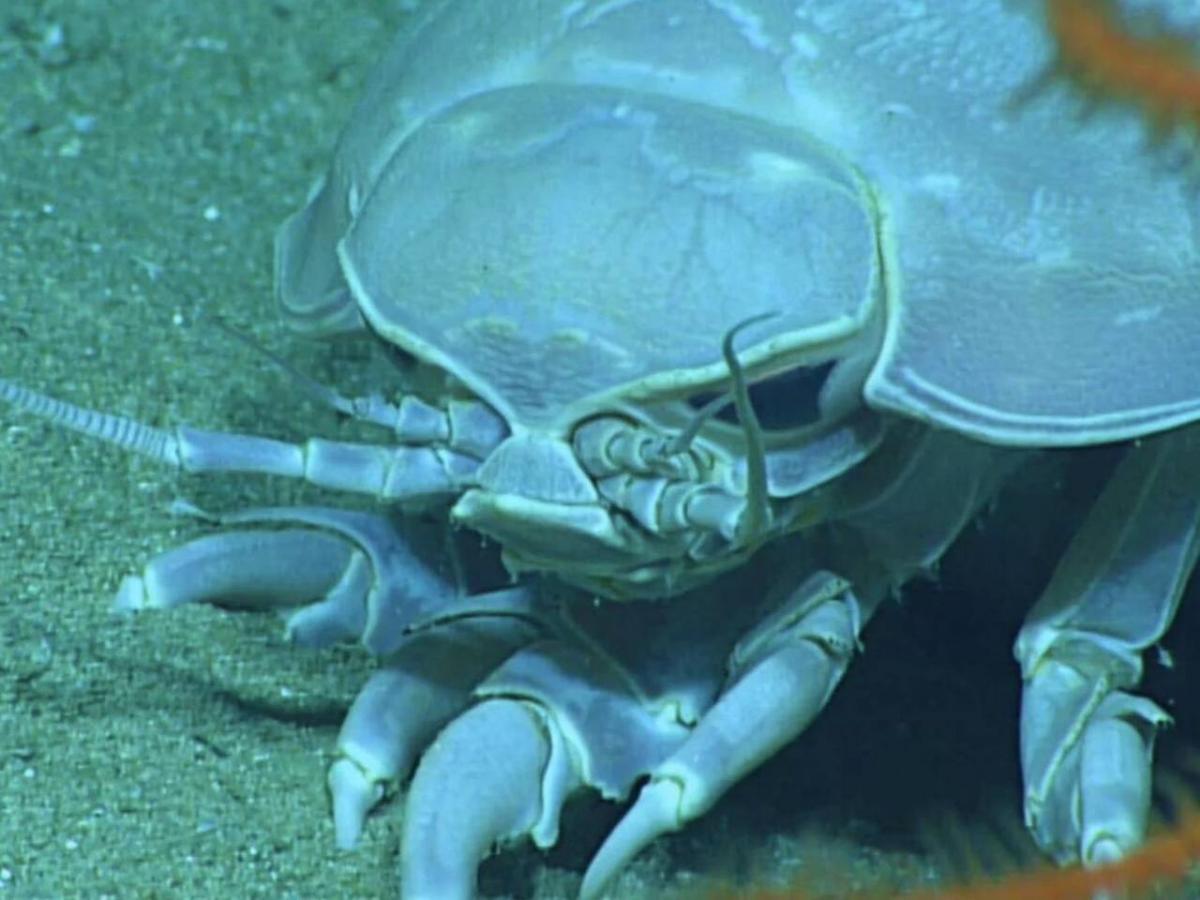
Chinese scientists have found that the giant isopod Bathynomus jamesi, which lives roughly 900 meters down in the ocean, can survive more than five years without eating, according to a study reported by elconfidencial.
The crustacean grows to about half a meter long despite living in cold, high-pressure water where food arrives rarely and unpredictably. Researchers said its body is built to squeeze the most out of every meal while spending as little energy as possible during long stretches without food.
Giant isopods belong to the same group of crustaceans as woodlice and are among the largest scavengers found on the deep ocean floor, where they feed on whatever dead animal matter sinks down to them.
To understand how Bathynomus jamesi copes, the team compared its genome with that of a close relative, Bathynomus doederleini, which lives in shallower water at around 300 meters. The deep-sea species turned out to be not only bigger but built differently: its stomach can stretch to fill two-thirds of its body cavity. That means when the isopod finally finds prey, it can eat enormously and then live off those reserves for a long time.
A Gene Borrowed From Bacteria
One of the main reasons for this endurance, researchers found, is a gene called ND1, which controls how much energy the body burns. According to the scientists, the crustacean did not inherit this gene from its ancestors but picked it up from a symbiotic bacterium, in a process known as horizontal gene transfer.
To test how the gene works, the team added extra copies of ND1 to zebrafish. In normal warm water, the modified fish burned through energy faster and coped worse with hunger, the study reported. But in cold water resembling conditions on the seafloor, the fish survived 37% longer without food than fish without the extra gene. The scientists said the cold triggers a reaction that slows down the mitochondria, the cell structures that generate energy, which in turn slows the whole metabolism.
Researcher Jianbo Yuan said the team found that ND1 acts as a conditional "valve" for energy metabolism. He said this is what allows both the fish and the isopod to hold out longer, because nutrients and reserves are used far more sparingly, helping explain how such a large animal can survive for years in a part of the ocean where food is scarce.
Bacteria Living in the Stomach
The researchers also found bacteria from the chlamydia group living in the isopod's stomach. These bacteria produce and store fats that could benefit their host. Some chlamydia species cause disease in other animals, but the ones found in the isopod have likely evolved over millions of years to coexist peacefully with the crustacean, according to the study. The authors concluded that genes, metabolism and the isopod's relationship with its microbes together have let Bathynomus jamesi thrive in one of the harshest environments on the planet.
A Similar Discovery in the South China Sea
The findings follow an earlier discovery that a deep-sea mollusk, Chaetoderma shenloong, found in the South China Sea, grows bacteria inside its own body. Scientists found unusual structures in its digestive gland, which they nicknamed "dragon balls." Each one has more than 20 layers of membrane and holds hundreds of microbes that produce nutrients using chemical energy rather than sunlight. The researchers suggest the mollusk occasionally digests these bacteria, effectively feeding off its own internal "farm."
Test yourself
How long can Bathynomus jamesi survive without food, according to the study?
What gene did researchers find helps regulate the isopod's energy use?
How did Bathynomus jamesi likely acquire this energy-regulating gene?