

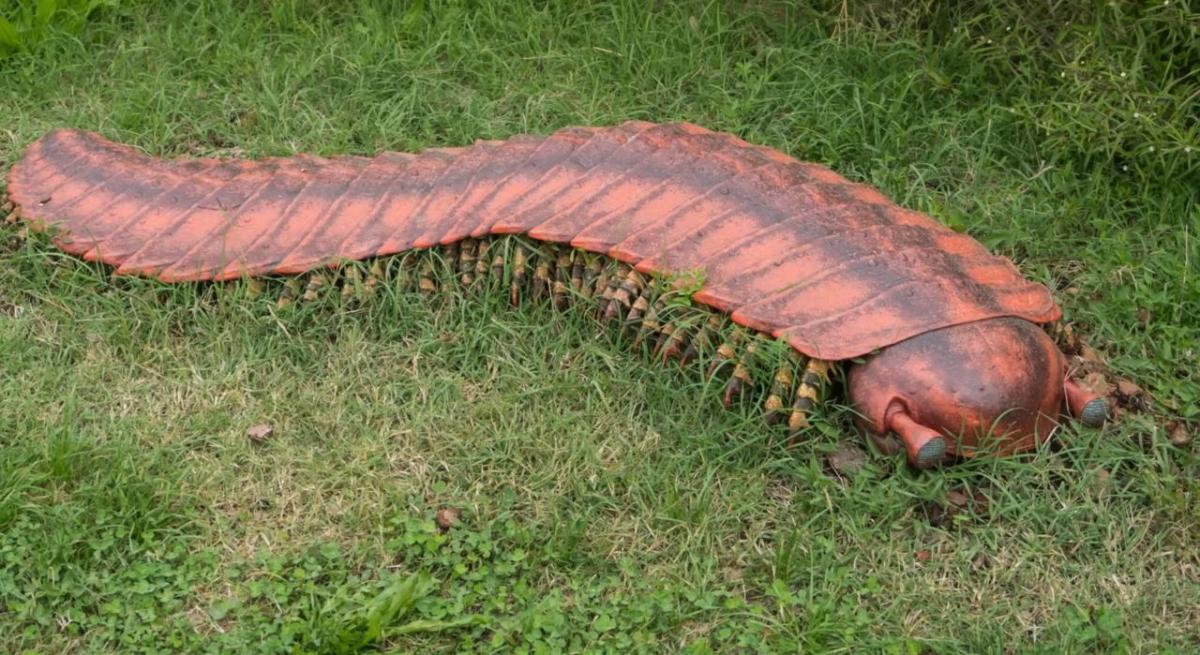
Geologists have discovered the fossil of a giant car-sized millipede on Howick beach in northern England, revealing the largest specimen of the extinct creature ever found. The fossil belongs to Arthropleura, an ancient millipede-like arthropod that reached over 2.6 metres in length, measured around 55 centimetres wide, and weighed approximately 50 kilograms.
The discovery was made in 2018 when a team of geologists travelling along the coast spotted an unusual fragment inside a sandstone block that had fallen from a cliff. When the rock cracked in half, it exposed the fossilised remains of the giant creature, according to Hungarian lifestyle magazine Hamu és Gyémánt.
Scientists later confirmed that the specimen belongs to Arthropleura, a genus of giant extinct arthropods first described by paleontologists in 1854. Although fossils of the genus have previously been unearthed across Europe and North America, most earlier finds consisted only of isolated shell fragments, limbs, or preserved footprints.
The Howick beach specimen represents only the third known partial fossil of a large Arthropleura ever recovered, making it the largest individual fossil of the species on record.
Discovery challenges ancient oxygen theory
The massive millipede lived approximately 326 million years ago during the Carboniferous period, an era frequently associated with giant insects and creepy-crawlies. Scientists had long believed that ancient arthropods grew to such enormous proportions because of high oxygen levels in the atmosphere, which reached between 30% and 35% in the late Carboniferous period.
However, the Howick Arthropleura lived much earlier in the geological timeline, when atmospheric oxygen was around 23%, only slightly higher than today's level of 21%. Researchers concluded that elevated oxygen levels alone could not explain why the creature grew so large.
Instead, scientists attribute its immense size to the unique ecosystem of the period. Land-dwelling vertebrates were only beginning to colonise terrestrial habitats. While primitive amphibians existed, there were no reptiles, birds, or mammals to occupy major ecological roles.
With few serious predators or competitors, Arthropleura was able to thrive and occupy environmental niches that were later dominated by large vertebrate animals.
Diet and extinction of the ancient giant
The exact diet of the creature remains a subject of ongoing study among paleontologists. In 2024, researchers conducted detailed examinations of the head and mouthparts of juvenile Arthropleura specimens to better understand how the animal fed.
Current theories suggest that the millipede was likely a slow-moving creature that fed primarily on decaying plant matter and organic detritus. However, researchers do not rule out the possibility that its massive size allowed it to prey on other invertebrates or even small amphibians.
Experts also note that the fossil discovered on the beach may represent a cast-off exoskeleton shed while the animal was moulting. If the remains were merely a discarded shell, the living Arthropleura would have been even larger than the recovered fossil suggests.
The genus eventually vanished from the fossil record around 290 million years ago. Its decline coincided with the formation of the supercontinent Pangea, which created a significantly drier climate across equatorial regions, alongside the rise of reptiles during the Permian period.
The combination of an increasingly arid environment and growing competition from evolving land vertebrates ultimately brought an end to the era of giant arthropods.


