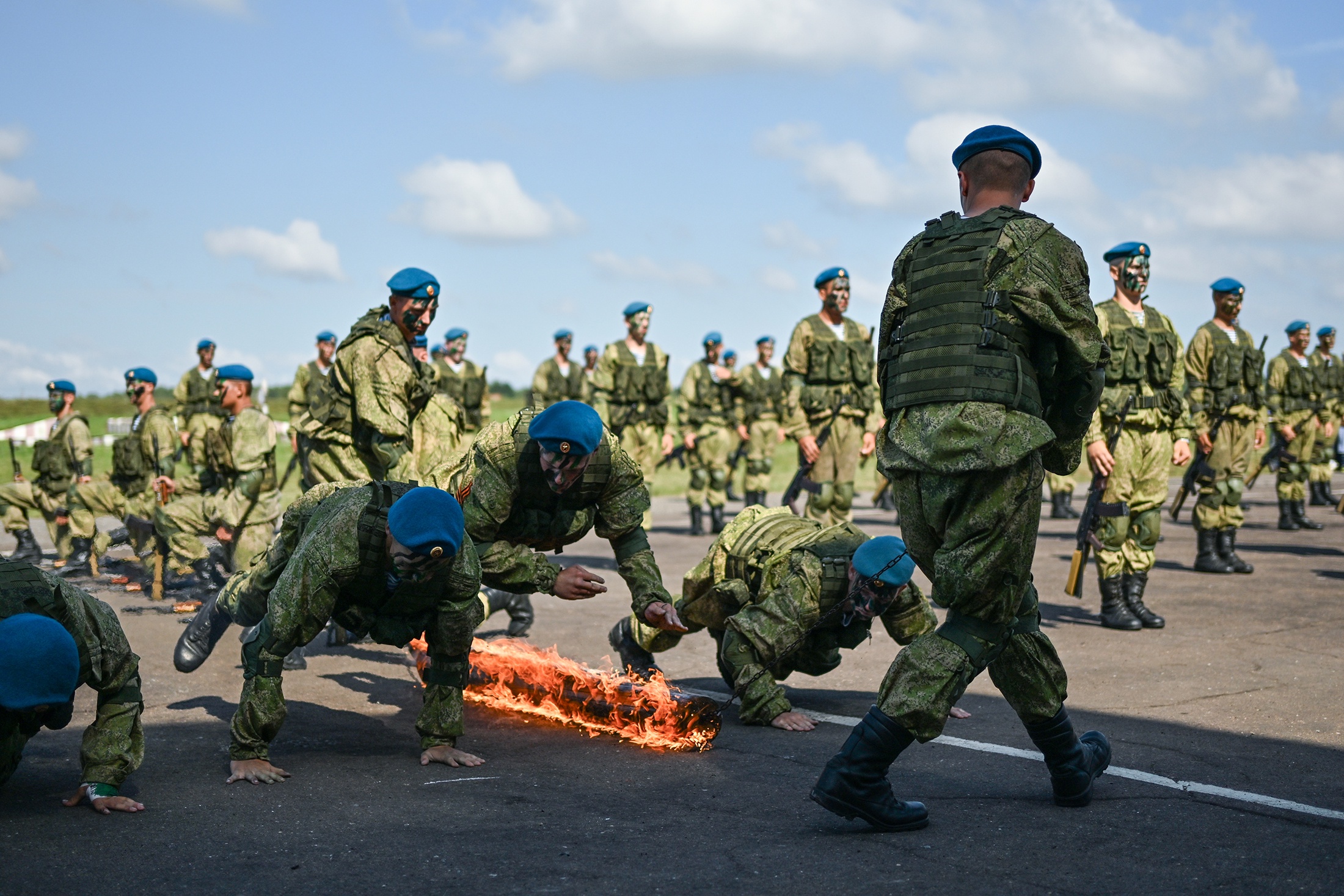
Russia's Airborne Forces turn 96 this year, and film producers are already commissioning scripts to mark the occasion. While screenwriters work carefully to honour the subject, a strong body of existing films sets a high bar.
In the Zone of Special Attention (1978)
Andrei Malyukov's film became an absolute phenomenon in Soviet cinema and a major recruiting tool for the Ryazan Airborne Academy. Some 35.4 million people saw it in 1978, a remarkable figure for an action film built around military exercises.
General Vasily Margelov personally supervised production and later saved the film from being banned. He also insisted that the characters wear blue berets, overruling the director, who had wanted to remove them on the grounds that real reconnaissance units would never wear something so conspicuous. Margelov's instinct proved correct: after the film's release, the blue beret became a symbol of courage and masculinity.
The picture is remembered for one of Soviet cinema's most celebrated screen pairings: Boris Galkin as Lieutenant Tarasov and Mikhai Volontir as Warrant Officer Volentir.
Counter Move (1981)
Three years later a sequel appeared in which training exercises escalate into something close to real war. Captain Tarasov now commands a sabotage unit tasked with seizing the enemy's headquarters and its classified documents.
Where the first film focused on airborne reconnaissance teams, the second shows paratroopers and marines working in close coordination. Volontir's warrant officer proved so vivid a character that audiences wrote him letters asking for help with personal disputes or requesting lessons in hand-to-hand combat.
The source credits the duology's appeal to its portrayal of an idealised army, one with no room for careerism or treachery, where regulations are written in blood and male friendship is stronger than armour.
Afghan Breakdown (1991)
Vladimir Bortko's film is set in spring 1989, on the eve of the Soviet withdrawal from Afghanistan. The unit of Major Mikhail Bandura, played by Michele Placido and dubbed into Russian by Oleg Yankovsky, receives Senior Lieutenant Nikita Steklov, played by Filipp Yankovsky, the son of a senior military official. The implication is clear: the young man has been sent to pick up medals and smooth his path into a military academy. Both main characters die.
The film is noted for an ambush sequence that the source describes as epic by any standard. A convoy is fired on from high ground, fuel trucks catch fire and block the road, and Bandura rescues a wounded soldier before pushing the burning vehicles over a cliff to clear the way.
Filming began in Tajikistan in winter 1990 and nearly ended in disaster when the crew found itself caught in mass civil unrest in Dushanbe and had to be evacuated by military aircraft.
9th Company (2005)
Fyodor Bondarchuk's film was the highest-grossing Russian release of its era, made on a budget and at a scale previously unseen in domestic cinema. It follows seven soldiers through brutal training at the hands of Warrant Officer Dygalo before their deployment to Afghanistan.
Historians criticised Bondarchuk for departing from the historical record. In the actual battle for Hill 3234 in the Panjshir valley, six of the 39 defenders were killed; in the film, only one character survives. The source suggests the film's artistic truth proved more powerful than historical accuracy. The real soldiers held the hill.
For Palych! (2023)
Andrei Bogatyrev's film follows Artem Golub, a spoiled young man from a wealthy family who, after a conflict with a powerful figure, loses everything: his father is removed from an election, the family loses their home, and Artem is conscripted into the Airborne Forces. There he undergoes a hard education under Warrant Officer Kotov.
After leaving the army, Artem returns to find that his grandfather Vasily Palych, a veteran of the Airborne Forces played by Sergei Shakurov, is about to lose his home. With the support of his fellow veterans, Artem helps his grandfather fight back.
The film is billed as a comedy, though the source notes it uses humour to address questions of honour, conscience, betrayal and national identity. Its makers said the grandfather's crumbling house is intended as a metaphor for Russia itself, and its defence as a metaphor for protecting longstanding values and culture.