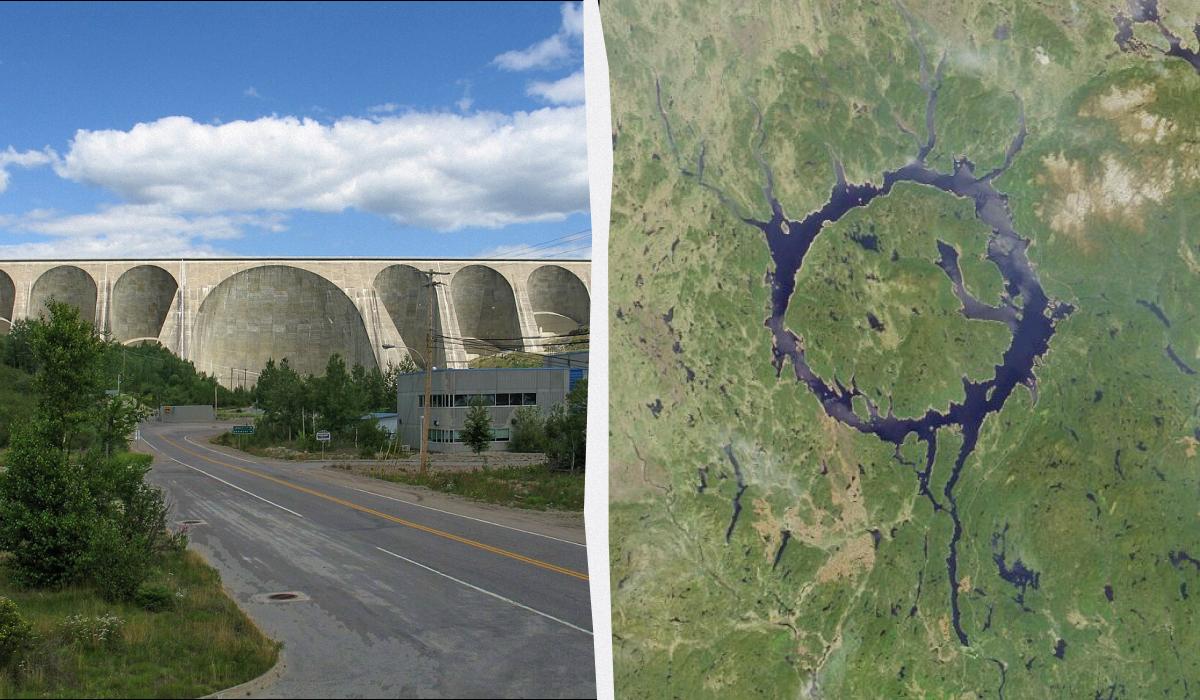
One of the best-preserved impact structures on Earth sits in the Canadian province of Quebec: the Manicouagan crater, a ring-shaped formation roughly 72 kilometres across that is clearly visible from space, the BBC reported.
The crater was created about 214 million years ago when a meteorite roughly five kilometres in diameter struck the Earth. The impact was so powerful that debris scattered vast distances, with fragments reaching as far as Japan. Scientists believe the event may have wiped out entire ecosystems of marine organisms.
How the ring took shape
Manicouagan's distinctive circular form came from a combination of natural geological processes and later human engineering. Between 1959 and 1970, four hydroelectric power stations were built on the Manicouagan River. The resulting reservoir flooded the crater, with water surrounding the mountainous massif at its centre and forming a huge ring of water that has become informally known as the "Eye of Quebec."
The true scale of the structure only became fully clear once astronauts photographed it from space.
Impact on the Innu community
The BBC also highlighted a lesser-known side of the story: the effect the dam construction had on the Innu people, whose traditional territories cover the Manicouagan region. Céline Bacon, a representative of the Pessamit community, said local residents were never asked to consent to the large-scale transformation of their lands.
According to the BBC, Bacon said the dams changed their territory and destroyed their traditional ways of hunting, fishing and gathering.
Visiting the crater today
Tourists can now explore the reservoir by boat or stand-up paddleboard, and hike into the Mont Groulx massif at the crater's centre. For visitors wanting to learn more about Innu culture, the BBC recommends a stay at Station Uapishka, a research station and lodge run by the Pessamit community.
The report noted that Manicouagan is not only a striking geological landmark but also a site with a layered history, where natural processes, engineering projects and the cultural heritage of its Indigenous population are closely intertwined.
Test yourself
What created the Manicouagan crater in Quebec?
What gave the crater its ring of water, forming the 'Eye of Quebec'?
According to Céline Bacon, how did the dams affect the Innu community?
Have your say
Should Indigenous communities have a formal say before large infrastructure projects like dams are built on their traditional territories?
Where it happened
Manicouagan, Quebec, Canada