

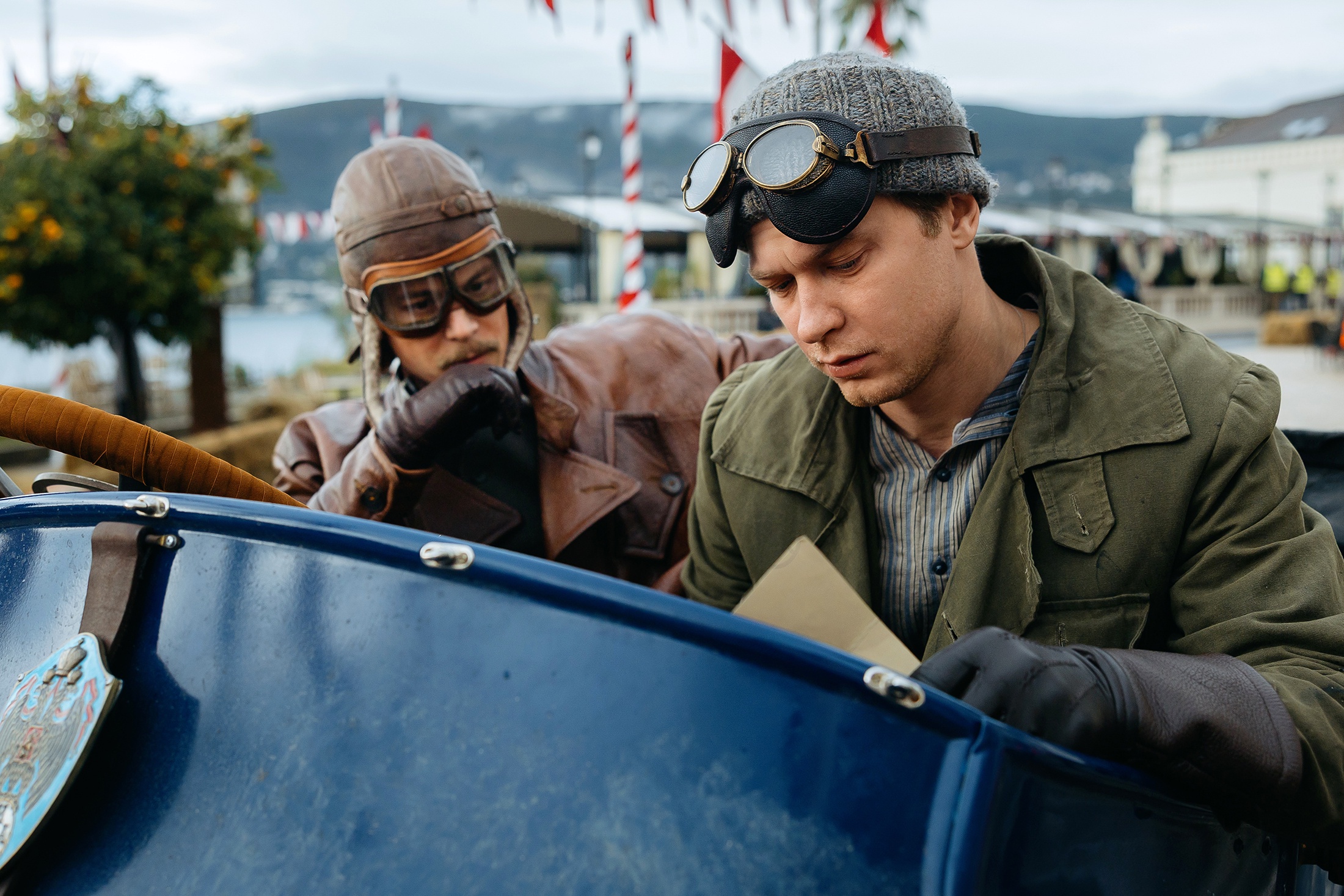
Director Ilya Malanin's historical sports film Battle of Motors has arrived in cinemas, bringing the story of Russia's first production automobile to the screen. The feature dramatises the development of the Russo-Balt vehicle and its journey to compete in the 1912 Monaco Rally.
The story follows historical figures who spearheaded early Russian motoring. Ivan Yankovsky plays Andrei Nagel, one of Russia's earliest race car drivers and the publisher of Automobile magazine. Yura Borisov portrays Dmitry Bondarev, a talented engineer who designed the country's first domestic cars. Alexey Guskov appears as Mikhail Shidlovsky, the head of the railcar manufacturing plant that backed the nation's inaugural automotive enterprise.
Rather than following historical events with strict precision, the filmmakers used real history as a narrative frame for a Hollywood-style action adventure. The plot introduces a German competitor, Gustav List, played by Yehezkel Lazarov, who acts as a promoter for the Benz brand. The main characters pursue a victory on the international racing circuit to demonstrate the necessity of developing a domestic car industry to a government that remains deaf to Nagel's ideas.
Winter endurance and racing replicas
The central set piece of the film depicts Nagel and Bondarev embarking on a test drive in a prototype model from St. Petersburg to Monaco during a severe Russian winter. The drivers battle snowdrifts, off-road conditions, and freezing cold to complete the trek. St. Petersburg served as the capital of the Russian Empire at the time, making the journey across Europe a test of early mechanical engineering.
To record the racing scenes, production teams constructed working replicas of vehicles from 1909 to 1912 using archival photographs and technical sketches. These custom builds included functional models ranging from the Russian Russo-Balt C24/55 to the German Blitzen Benz. The Russo-Baltic Wagon Works, operating out of Riga, produced Russia's first series of production cars during this era.
In historical reality, rally participants departed from various European capitals independently. However, the film presents the Russian and German competitors racing neck and neck at extreme speeds. Cinematographer Mikhail Khasaya captured the high-speed action, supported by rapid editing and physical performances from the cast and stunt team.
The Monte Carlo Rally, established in 1911, was designed to test vehicle reliability over long winter routes across Europe. Winning or completing the rally offered international prestige for early automotive manufacturers seeking to prove their vehicles could endure harsh conditions.
Subplots and production details
The 144-minute blockbuster incorporates a romantic subplot featuring Paulina Andreeva as a fellow driver. Although her character's driving background is not integrated directly into the action, she is portrayed as an independent thinker who acts with more resolve, restraint, and intelligence than the male characters surrounding her.
Sergey Volkov plays the Russian Emperor, depicting him as a wise, noble, and democratic figure who acts as a mentor to the racers. Early scenes establish that he will intervene to make a fair decision during a critical moment, making the team's ultimate triumph predictable within the narrative framework.
The movie balances its action sequences with theatrical dialogue, heavy technical detail, and occasional pacing slowdowns. The climax delivers a sense of justice that creates a strong patriotic mood among cinema audiences.
The film concludes with an old-fashioned iris fade kiss. During the end credits, a brief operatic passage transitions into a song by contemporary Russian rapper FEDUK about the madness of the brave, contrasting the idealized past with modern reality. FEDUK is a modern hip-hop artist known for blending electronic beats with urban vocal styles.
Tragic fates of automotive pioneers
While the movie ends with a victory in Monaco and imperial recognition, the real-life historical figures experienced tragic fates after 1912. Their lives took dramatic turns following the collapse of the Russian Empire and the rise of the Soviet state.
Mikhail Shidlovsky, who went on to pioneer both automotive and aircraft manufacturing in Russia, was arrested in 1919 by the Petrograd Cheka. The Petrograd Cheka operated as the Bolshevik secret police unit in the former capital. Authorities falsely accused Shidlovsky of espionage and attempting to defect to White forces, executing him in 1920. He was officially rehabilitated in 1998.
Dmitry Bondarev later became the director of the Moscow Automotive Society plant, which grew into the major Soviet vehicle manufacturer ZIL. He also served as chief engineer at agricultural equipment maker Rostselmash. Soviet authorities arrested Bondarev in 1937 on false charges of participating in a counter-revolutionary terrorist organization and executed him the same year. He was rehabilitated in 1957.
Andrei Nagel escaped the political turmoil of the Russian Revolution by fleeing to France. He emigrated with his family to Paris in 1920, where he lived until old age.


