Serbian students have emerged as the leading political threat to Aleksandar Vucic ahead of the October 25 elections, uniting a fractured opposition to challenge his ruling party.
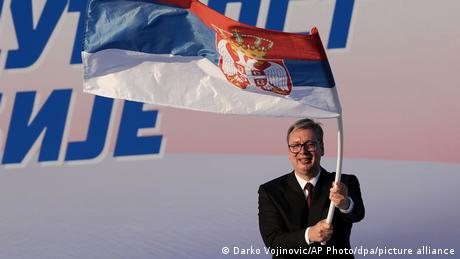
Vucic, who resigned as president on September 27, is seeking to become prime minister as the lead candidate for the Serbian Progressive Party.
He faces the newly formed Student List, which grew from a protest movement against corruption and abuse of power that blockaded the country's major universities for months.
The demonstrations were triggered by the late 2024 collapse of a canopy at the newly renovated Novi Sad train station, which killed 16 people.
The students bypassed career politicians to field a candidate list of professors, activists and recognized public figures.
A recent poll placed the Student List at 44.4 percent and Vucic's camp at 41.7 percent, prompting most opposition parties to withdraw from the race and back the students.
Government-aligned institutes predict a comfortable victory for the former president, but public trust in Serbian institutions and media has reached historic lows, leaving all polls subject to skepticism.
Referendum atmosphere
Dusan Lj. Milenkovic, a political scientist and pollster, said the election was operating as a referendum that would leave Serbia with either liberation from authoritarian rule or decades of oppression and dictatorship.
Former Prime Minister Zoran Zivkovic agreed with the referendum comparison, adding that the country's traditional opposition had failed.
Zivkovic said traditional opposition parties in Serbia were like dinosaurs in the 21st century, noting they were either non-existent or had sold out to the government and were no longer contributing to the rule of law.
The student movement has bypassed traditional nationalist narratives and debates over whether Serbia should align with the European Union or form an alliance with Russia.
Instead, the list has united liberals and nationalists from the left and right around a platform of fighting crime and respecting the law.
Students are campaigning door-to-door and on social media. One of their viral advertisements showed a lone masked man sweeping a prison corridor, indicating how they envision Vucic's future if they win.
Accusations and rhetoric
Vucic, who balances relations between the EU, China and Russia, is accused by opponents of controlling the media, selling off natural resources and maintaining ties with organized crime.
He has relied on rhetoric used during the Milosevic era, calling his critics mercenaries, terrorists and fascists, and describing the student movement as a Western-imported color revolution.
The current protests are significantly larger than the two-week demonstrations that ousted former leader Slobodan Milosevic on October 5, 2000.
Vucic served as Milosevic's minister of information during that period, acting as a member of the extremist Serbian Radical Party and holding responsibility for censorship.
Historical parallels
Vucic once said of the 2000 uprising that moments arrive when all the social scum, mud and evils in a society come to the surface, adding that his side had survived, learned the lessons and would overcome them.
Milenkovic said Vucic had sought to erase the achievements of the 2000 democratic transition to establish his own version of events in the collective memory.
Following Milosevic's fall, Yugoslavia, which then consisted of Serbia and Montenegro, rejoined the United Nations, resumed regular wage and pension payments, and secured significant foreign debt relief.
However, modern Serbia is no longer the country it was in 2000, when it was emerging from a decade of wars, sanctions, hyperinflation and the 1999 NATO bombing campaign over Kosovo.
Zivkovic, who was part of the winning 2000 coalition and took office after the 2003 assassination of Prime Minister Zoran Djindjic, said a new government must be prepared to act immediately.
He said all reforms must be implemented within a year before holding fresh elections where distinct political platforms could be presented.
Zivkovic called for a political purge of anyone involved in the old regime, saying current officials should not even be allowed to run for building manager.
Fears of violence
Opponents of the government have expressed fears of electoral fraud and open violence ahead of the vote, citing force previously used by police and pro-government thugs during protests.
Jovo Bakic, a sociology professor in Belgrade and candidate on the Student List, told Vreme magazine he was convinced Vucic would not accept defeat.
Milosevic only conceded the 2000 election after the army and elements of the police refused to follow his orders, causing his power apparatus to collapse.
Bakic said the students had a plan for the possibility that Vucic refuses to step down, but declined to reveal the details.