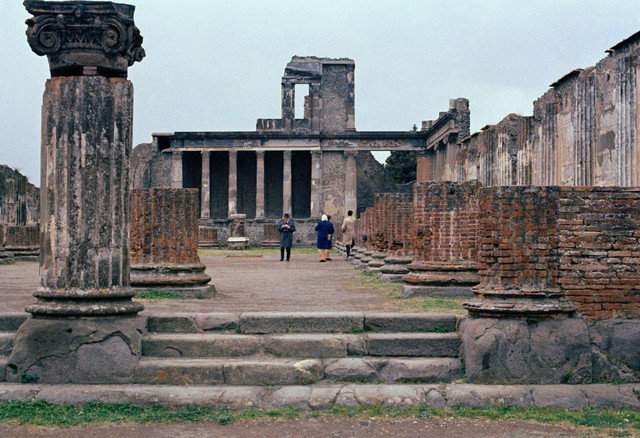
Mount Vesuvius erupted with catastrophic power in 79 AD, burying the ancient Roman city of Pompeii, nearby Herculaneum, and other settlements in Campania under ash.
August 24 has long been established as the traditional date of the disaster, although the exact timing of the eruption remains a subject of ongoing scientific debate.
Pompeii was a thriving Roman city situated on the Bay of Naples. Its inhabitants lived in the shadow of Vesuvius without knowing that the fertile mountain concealed a dangerous volcano. The region had already been hit by a severe earthquake in 62 or 63 AD, and restoration work was still underway when the catastrophic eruption struck.
Destruction did not come from rivers of flowing lava, as popular depictions often suggest. Instead, a massive deluge of pumice, ash, and volcanic fragments began falling on Pompeii. Roofs collapsed under the immense weight of the debris, while trapped residents tried to shelter inside houses or flee by walking on a constantly growing layer of fallen pumice.
Shortly afterward, superheated mixtures of gas, ash, and volcanic material known as pyroclastic clouds swept across the settlement, leaving virtually no chance of survival for anyone remaining in the area.
Historical Eyewitness Accounts and Naval Rescue
One of the most vital eyewitness accounts of the eruption comes from Pliny the Younger, who watched the cataclysm from Misenum across the bay. He detailed the giant cloud rising above the mountain and the tragic sequence of events in two letters written to the Roman historian Tacitus.
His uncle, Pliny the Elder, served as commander of the Roman naval fleet stationed at Misenum. Upon seeing the column of smoke, he sailed warships toward the stricken region to rescue survivors, but died near Stabiae during the effort.
Scientific Debate Over the Eruption Date
The exact calendar date of the catastrophe is more complex than historical tradition presented for centuries. The oldest and most complete surviving manuscripts of Pliny's letters reference August 24, 79 AD, establishing the date in historical records.
However, newer archaeological discoveries have provided strong arguments for scholars who place the disaster later in the autumn. The most significant finding emerged in 2018, when archaeologists discovered a rough charcoal inscription on a house wall in Pompeii that contained a date corresponding to October 17.
Because fragile charcoal writing would unlikely remain visible for long before being covered by volcanic debris, the inscription strengthened the hypothesis of an autumn disaster. In a 2024 scientific publication, the Archaeological Park of Pompeii noted that the debate remains open, stating that while archaeological evidence creates reasonable doubt, August 24 still holds the strongest direct support from Pliny's manuscript tradition.
Preservation, Plaster Casts and Daily Roman Life
Although volcanic ash destroyed Pompeii, the thick layer also preserved houses, wall frescoes, shops, and everyday artifacts for centuries. When formal excavations began in the 18th century, archaeologists uncovered a settlement that provided an exceptionally detailed picture of daily life in the Roman Empire.
Beginning in 1863, archaeologist Giuseppe Fiorelli introduced an innovative method to document victims of the eruption. He poured liquid plaster into the hollow voids left in the ash after decomposed bodies vanished. This technique produced famous plaster casts that preserve the physical shapes and final postures of victims in their last moments, cementing Pompeii as one of the most crucial sources for understanding ancient Roman society.
Major Historical Events Recorded on August 24
Beyond the destruction of Pompeii, August 24 marks several major historical milestones across different eras. In 1572, the St. Bartholomew's Day Massacre began in Paris, targeting French Protestant Huguenots. The mob and state violence quickly spread to other French cities, with historical estimates of the death toll ranging from 5,000 to 30,000 people.
During the War of 1812, British forces captured Washington on August 24, 1814, and set fire to public buildings, including the Capitol and the presidential residence, which later became known as the White House. This stands as the only time after the American Revolution that a foreign military force captured the capital of the United States.
In Greece, the first issue of the newspaper Avgi was published in Athens on August 24, 1952, initially as a weekly publication before transitioning to a daily newspaper months later. Avgi formed a deep historical link with the Greek Left, becoming an enduring element of national political life.
Opera icon Maria Callas made her historic debut at the Ancient Theatre of Epidaurus on August 24, 1960, performing the title role in Vincenzo Bellini's opera Norma. In international politics, the parliament of Ukraine declared independence from the Soviet Union on August 24, 1991, an act ratified by referendum on December 1, establishing the date as Ukraine's Independence Day.
At the 1999 World Athletics Championships in Seville, Greek athletes Voula Tsiamita won the gold medal with a jump of 14.88 meters and Olga Vasdeki earned bronze with 14.61 meters in the triple jump. In 2007, the regional unit of Ilia in Greece was engulfed in destructive flames during the deadliest phase of the 2007 wildfires, claiming dozens of lives as Zacharo and Artemida became symbols of the disaster.
Notable Births and Deaths on August 24
Several landmark cultural and political figures were born on August 24. Distinguished sculptor Yannoulis Chalepas was born on Tinos in 1851, becoming a monumental figure in modern Greek sculpture through works such as Sleeping Woman and Satyr and Cupid, despite severe psychiatric trials before his creative rebirth in Panormos, Tinos.
Argentine author Jorge Luis Borges was born on August 24, 1899, pioneering 20th century literature with famous works including Fictions and The Aleph. Palestinian leader Yasser Arafat, born August 24, 1929, led the Palestine Liberation Organization for decades, served as President of the Palestinian Authority, and received the 1994 Nobel Peace Prize.
Greek singer Paschalis, born August 24, 1946, became an iconic figure in Greek pop and rock as a founding member of The Olympians. Acclaimed Brazilian author Paulo Coelho was born August 24, 1947, inspiring millions globally with his international bestseller The Alchemist.
Historical deaths recorded on August 24 include Cosmas of Aetolia, a Greek monk, missionary, and teacher executed by Ottomans in 1779 after touring Roumeli and the Balkans to build schools, later recognized as a saint and ethnarch. Religious tradition also commemorates Saint Eutychios alongside historical remembrances tied to Aetolia.