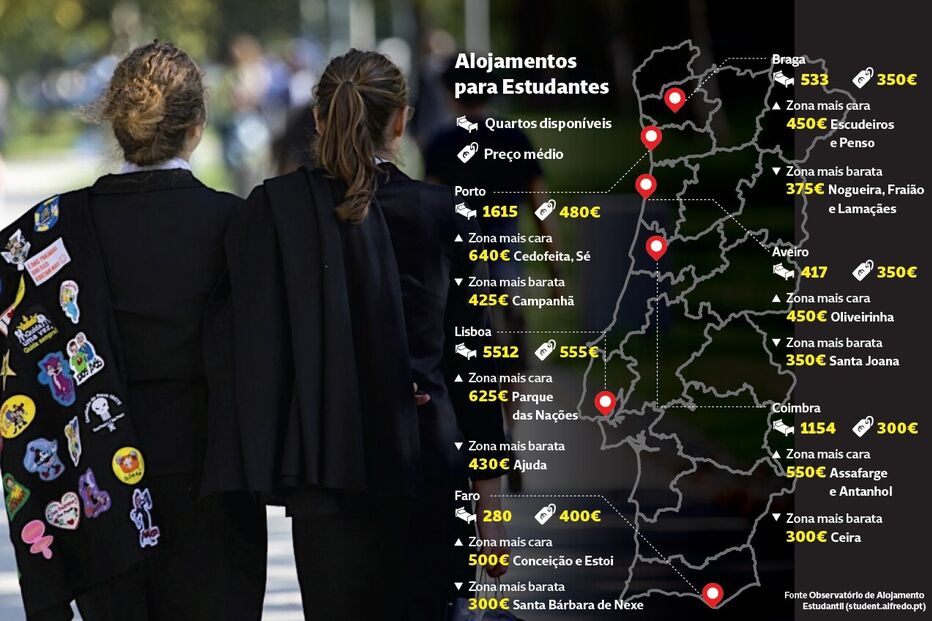
Rent for a student room in Lisbon has climbed to an average of 555 euros a month, the highest in Portugal, according to data from the Observatório de Alojamento Estudantil (Student Housing Observatory), published at student.alfredo.pt.
Porto follows with an average monthly rent of 480 euros. In Coimbra the average is 300 euros, the lowest of the cities measured, while Aveiro and Braga average 350 euros and Faro 400 euros.
Pedro Neto Monteiro, president of the Federação Académica de Lisboa (Lisbon Academic Federation), said housing prices rise every year and have become the biggest obstacle to attending higher education. He said many families cannot afford the cost and that students end up choosing options closer to their family home instead.
Public Housing Beds Still Short of Target
The supply of publicly funded beds in university residences remains well below demand. Neto Monteiro said funding from the Plano de Recuperação e Resiliência (Recovery and Resilience Plan, PRR) had given the effort a boost through the Plano Nacional de Alojamento do Ensino Superior (National Higher Education Housing Plan, PNAES), which set a target of 19,000 new beds.
So far just over 5,000 of those beds have been completed, with around 2,600 already in use while building work continues on the rest. Roughly 11,000 beds have yet to be built.
Neto Monteiro said two large residences are due to open near the University of Lisbon, calling the effort worth recognising. But he added that even once all 19,000 beds are finished, the plan will not be enough to meet demand. He said it was a shame the plan had only moved forward because of the PRR funding, and warned that with the PRR coming to an end, attention needs to turn to what comes next.
A Quarter of Coimbra Students Have Considered Quitting
About a quarter of students have thought about abandoning their higher education studies because of the combined cost of housing, food, transport and study materials, according to an online survey carried out by the Associação Académica de Coimbra (AAC), the students' association of the University of Coimbra.
Of the 1,039 students who responded, 24.6% said they had considered suspending their enrolment. José Machado, president of the AAC, told the Lusa news agency that housing was the main obstacle students faced.
The survey found that around two thirds of students in Coimbra, 65.2%, pay 300 euros or more for a room, and 57.2% said the availability and cost of housing influences their choice of city or institution. About 32% of respondents said they have no formal rental contract. Some 28.6% said they spend between 51% and 70% of their monthly budget on housing, and 12.3% said they spend more than 70%.
Teachers' Union Calls for More Funding
The Federação Nacional dos Professores (National Teachers' Federation, Fenprof) said the rise in the number of students placed in the first phase of higher education admissions is good news, but warned it must come with more funding for institutions it describes as already suffering from chronic underfunding.
Fenprof said the increase means more classes, more theoretical, practical and laboratory sessions, more support for students, and greater need for teaching staff and other resources.
Close to 50,000 students secured a place at a public higher education institution in the first phase, 6,092 more than last year, filling 88.9% of the places on offer.
Medical Students Warn Against New Places
The Associação Nacional de Estudantes de Medicina (National Association of Medical Students) said it was misleading rhetoric to claim that increasing the number of places on medical courses solves the shortage of doctors in the Serviço Nacional de Saúde, Portugal's National Health Service.