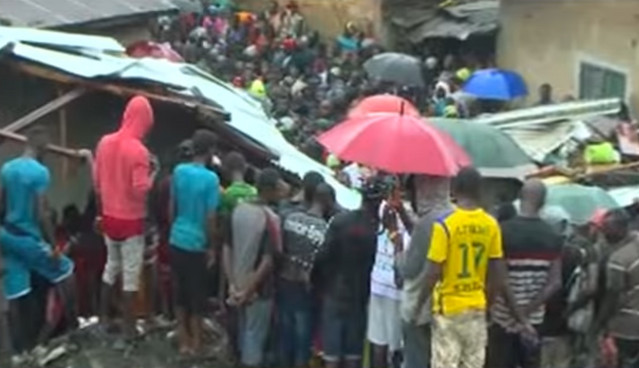
A landslide at a landfill in Conakry, the capital of Guinea, killed 30 people and left 22 others injured on Sunday, 23 August, after heavy rainfall hit the area.
The disaster occurred at 02:00 local time, equivalent to 05:00 Greek time, in the Dar es Salaam district within the commune of Gbessia. According to a government statement, intense rainfall throughout the night triggered the waste slide, which swept into nearby residential areas and caused several houses to collapse. Authorities confirmed that among the injured, 6 people sustained severe injuries while 16 suffered light injuries.
Emergency teams and equipment were immediately deployed to the site as search and rescue operations continued. Government officials stated that rescue workers are searching for anyone who may still be trapped under the debris, providing immediate assistance to victims, and recovering bodies from the rubble.
Prime Minister Amadou Oury Bah traveled directly to the scene of the tragedy to assess the situation. The government confirmed that comprehensive measures have been put in place to guarantee medical care and hospitalization for all injured residents, alongside emergency aid for families affected by the collapse.
Calls for Investigation
The disaster drew sharp criticism from opposition figures. Cellou Dalein Diallo, a former prime minister of Guinea who is currently living in exile as an opposition leader, expressed shock over the event in a Facebook post written before the official death toll of 30 was released. He described the collapse as a shocking tragedy that had claimed numerous victims.
Diallo emphasised that the disaster was particularly alarming because authorities had previously announced that the Conakry landfill would officially close on Sunday, 23 August. He urged relevant public agencies to establish the precise circumstances leading to the disaster with full transparency, adding that appropriate legal and administrative consequences must follow.
Political Context in Guinea
Guinea, a West African nation located on the Atlantic coast, has faced ongoing governance challenges. The country is currently led by General Mamadi Doumbouya, a military commander who seized power in a 2021 coup before winning election as president in December 2025.