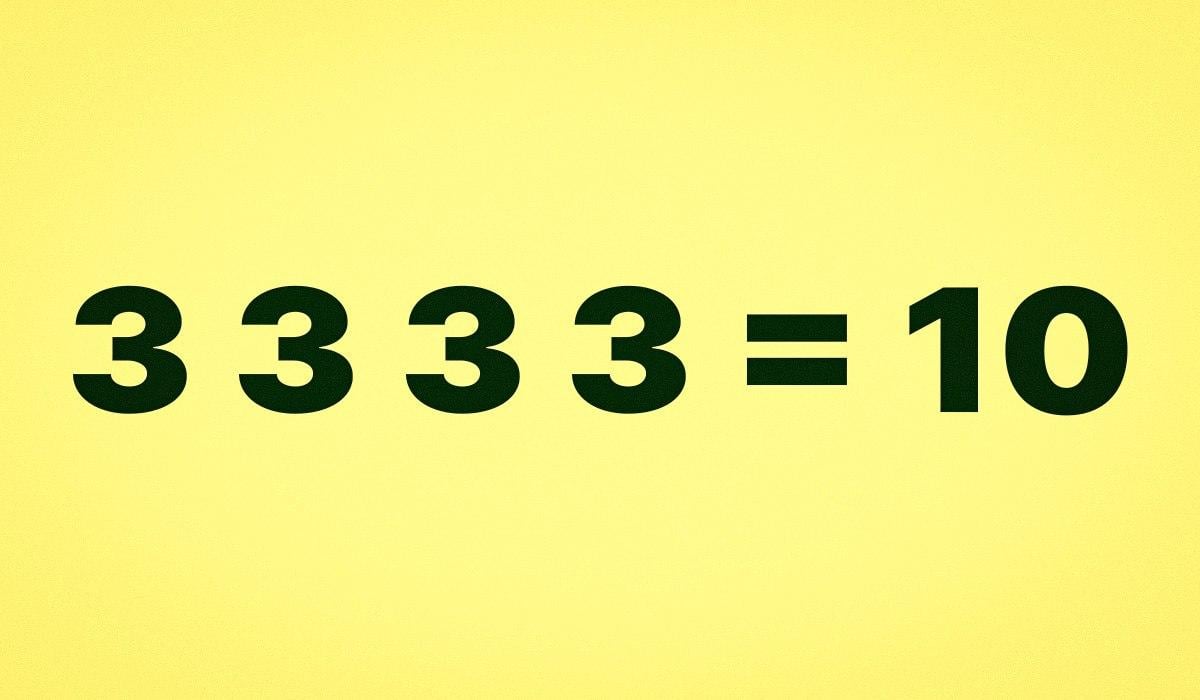
Polish publication eDziecko has shared a math puzzle challenging readers to turn four threes into ten using three arithmetic signs.
The problem sets out the equation 3 3 3 3 = 10. Solvers must place mathematical symbols between the four numbers to make the statement true, while keeping all four digits in their exact original order.
The rules allow only four fundamental operations: addition, subtraction, multiplication, and division. Solvers cannot combine individual digits into two-digit numbers such as 33. The puzzle also bans the introduction of exponents, square roots, brackets, or additional numbers.
Applying a single operation across the sequence fails to reach the target. Adding all four threes produces 12, which overshoots the answer. Multiplying all four numbers together yields 81, far higher than required. Solvers must therefore combine different arithmetic operations to reach ten.
Solution To The Puzzle
According to eDziecko, one correct answer is 3 × 3 + 3 : 3 = 10. The sequence places a multiplication sign between the first and second threes, an addition sign between the second and third, and a division sign between the third and fourth.
The solution relies directly on standard mathematical rules regarding the order of operations. In basic arithmetic, multiplication and division must always take place before addition and subtraction.
Under those rules, the first step is calculating 3 × 3, which equals nine. The second step is calculating 3 : 3, which equals one. The final calculation adds nine and one together to produce ten. The equation succeeds without moving any digits, adding parentheses, or introducing extra figures.
Order Of Operations
The order of operations is a standard mathematical convention taught in elementary schools, frequently remembered through mnemonics such as PEMDAS or BODMAS. These conventions dictate that calculations within brackets occur first, followed by exponents, multiplication and division, and finally addition and subtraction.
Without following these operational priorities, the sequence breaks down. Working strictly from left to right would mean multiplying three by three to get nine, adding three to make twelve, and dividing twelve by three to end with four. The solution works because division and multiplication take precedence, isolating the final division before the addition takes place.
Published in Poland, eDziecko is a family and parenting news outlet that regularly runs brain teasers, classroom exercises, and logic puzzles. These items are designed to encourage readers and students to test everyday problem solving and refresh their recall of fundamental numeracy skills.
The publication noted that other mathematical puzzles often introduce two pairs of brackets, which can completely alter an example, especially when multiplication and subtraction sit between them. While the four threes challenge may not look difficult initially, arriving at the right number requires remembering the exact sequence of mathematical operations.