The Centro Cultural Banco do Brasil (CCBB) opened its first location in Brazil's Northeast region in Salvador, Bahia, launching the new space with an exhibition honoring Ilê Aiyê, the country's first Afro carnival bloco.
The exhibition, called "Nação Ilê," celebrates more than 50 years since Ilê Aiyê was founded in 1974 in Salvador's Curuzu neighborhood. The show is housed inside the Palácio da Aclamação, a historic building now home to the CCBB's fifth unit in Brazil.
The exhibition was curated by Tiganá Santana, a translator and multi-artist; Tiago Sant'Ana, a visual artist and curator with a doctorate in Culture and Society from the Federal University of Bahia; and Raquel Barreto, a historian and chief curator of the Museum of Modern Art in Rio de Janeiro (MAM Rio). The show is built around Ilê Aiyê's legacy as a symbol of resistance, aesthetic affirmation and the fight against racism.
Sant'Ana said the exhibition's starting point was the way Ilê Aiyê itself has worked for more than five decades. He said that whenever the bloco chooses a theme, historical research unfolds into songs, printed patterns and education booklets distributed in the community before carnival even begins. He said each artistic language offers its own way of understanding Ilê Aiyê's history, and that the exhibition sought to bring that same sophistication together, treating visual art, music and dance as practices the group has developed since 1974 that have gone on to influence other contemporary artists.
Textiles, Prints and Colour
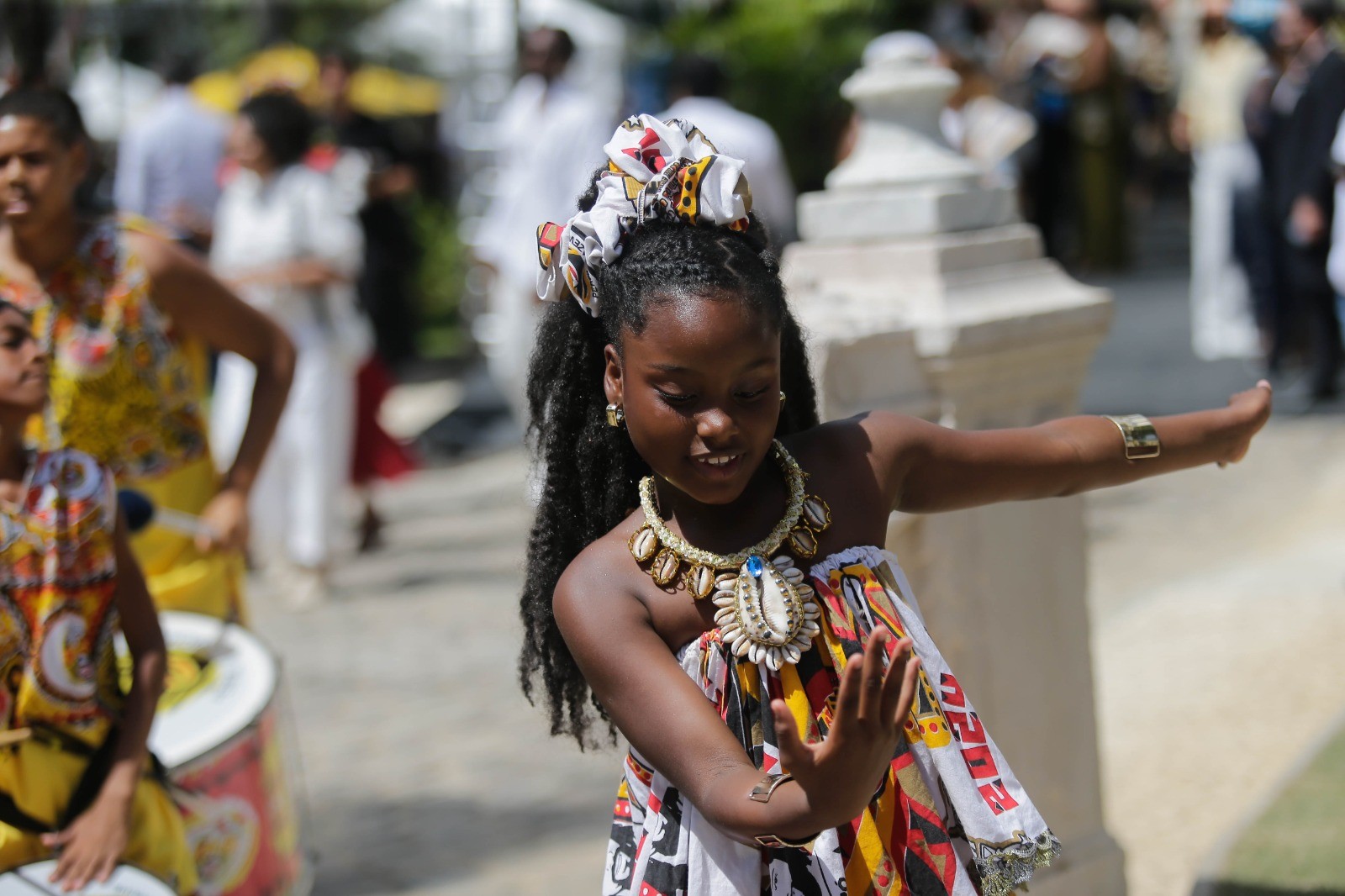
Textiles run through much of the exhibition. Sant'Ana said fabric is one of the ways Ilê Aiyê tells the story it chooses to sing about each carnival, with that story taking shape in the design, colour and scale of printed cloth. He pointed to Dete Lima, the bloco's costume designer, and the skill she brings to building a silhouette, tying a torso or giving volume to a skirt. He also cited the graphic work of J. Cunha, who shaped Ilê Aiyê's visual language over more than 20 years and whose influence is still visible today.
Sant'Ana described how that clothing becomes wearable art in motion, multiplied across thousands of bodies as they move down the Ladeira do Curuzu toward the carnival circuit in central Salvador. He said the result is a collective performance built on a sense of belonging, in which Ilê Aiyê can be recognised from a distance, while up close each person's particular knot or fold becomes visible. He said that freedom to create one's own image through fabric is itself an expression of Black autonomy.
Sant'Ana said the exhibition keeps the aesthetic and the political side by side, pointing to one section where blue links fabrics, moving images and portraits of older Ilê Aiyê members. He said the colour guides the eye from one work to the next and gives an intimate scale to Atlantic memory, moving from the vastness of the ocean to the face of someone who helped create Ilê Aiyê and still lives in Curuzu. He said he hoped visitors would leave thinking about the scale of Ilê Aiyê's reach and understanding that aesthetics and politics can carry equal weight.
A New Home for Bahian Culture
Júlio Paranaguá, general manager of CCBB Salvador, said the institution's arrival in the city was an important step toward democratizing access to culture and moving cultural investment beyond a handful of Brazilian cities. He said Salvador is a city of enormous creative power whose artistic production influences Brazil and the world, and that having a permanent home there means recognising that strength, widening opportunities for Bahian artists and creating new exchange between local production and other regions. He said CCBB aims to be a space for encounter, for valuing diversity and for connecting with Bahia's cultural identity.
CCBB Salvador is the fifth CCBB unit in Brazil. The project was announced in 2024 under an agreement between Banco do Brasil and the Bahia state government, which owns the Palácio da Aclamação. The building is a protected heritage site listed by Bahia's Institute of Artistic and Cultural Heritage (Ipac), part of the state culture department.
The opening took place during Brazil's Black Awareness Month, and musicians Gilberto Gil and Margareth Menezes were among those present when the public gained access to the exhibition. The launch also comes as the United Nations has declared 2027 to 2036 the International Decade of Culture for Sustainable Development, underscoring culture's role in building fairer and more inclusive societies.
Looking to the Future
Asked about Ilê Aiyê's future, Sant'Ana returned to two images from the exhibition's curatorial text: Ilê means house, and Aiyê means world. He said it was fitting that a project able to bring so many people together has such a precise address, Rua do Curuzu, and that its global dimension can be discussed without losing sight of Ilê Axé Jitolu and the presence of Mãe Hilda, the bloco's matriarch. He said that for him, the autonomy Ilê Aiyê offers future generations lies in understanding a past and a legacy while remaining free to decide the next chapter of that history.
Sant'Ana said Ilê Aiyê educates through beauty and celebrates through a political stance against racism, describing a constant struggle to make the world a place Black people can inhabit without exclusion because of their race or social position. He said the bloco's greatest legacy is giving Black people self-esteem and an understanding of their importance within the country, insisting on the need for Black presence across all social spaces.
Test yourself
What is Ilê Aiyê known as in Brazil?
Where is the new CCBB Salvador located?
How many CCBB units does Brazil have including the new Salvador site?
Have your say
Should more cultural institutions like CCBB open outside Brazil's major cities?
Where it happened
Salvador, Brazil